
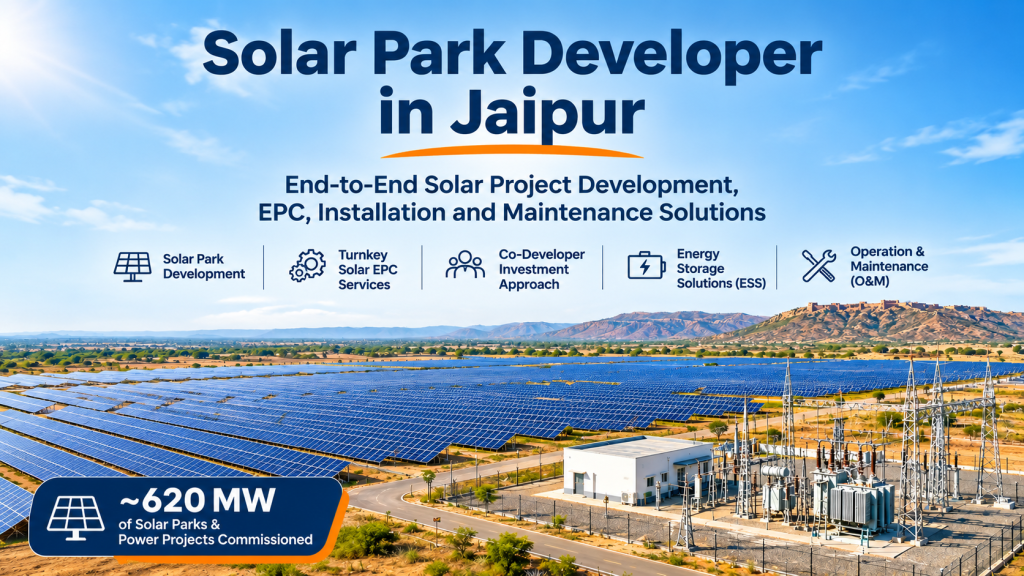
The demand for renewable energy is growing rapidly across India, and solar power has emerged as one of the most promising solutions for meeting the country’s increasing electricity requirements. With abundant sunlight, expanding industrial infrastructure, and strong government support for clean energy, Rajasthan has become an important destination for large-scale solar power development.
Jaipur, being one of Rajasthan’s major commercial and industrial centres, is playing an important role in the renewable energy sector. Businesses, investors, industries, and energy developers are increasingly exploring opportunities in solar power generation to reduce electricity expenses and support long-term sustainability.
Developing a solar park, however, involves much more than installing solar panels. It requires proper land assessment, project planning, engineering, equipment procurement, grid connectivity, regulatory coordination, construction, and long-term operation and maintenance.
This is where choosing an experienced Solar Park Developer in Jaipur becomes essential.
SRB Power India is a trusted solar energy development and EPC company providing comprehensive solar project solutions across India. With approximately 620 MW of solar parks and power projects commissioned, the company brings experience in large-scale solar infrastructure development and turnkey solar EPC services.
Why Rajasthan Is an Ideal Location for Solar Park Development
Rajasthan offers significant opportunities for solar energy generation because of its geographical conditions, high solar irradiation, and availability of suitable land in several regions.
The state has become an important contributor to India’s renewable energy development, attracting solar power producers, infrastructure companies, investors, and industrial consumers.
Some important factors making Rajasthan suitable for solar park development include:
1. Abundant Solar Radiation
Rajasthan receives considerable sunshine throughout the year, making it suitable for utility-scale solar photovoltaic installations. Higher solar irradiation can support efficient electricity generation when projects are properly designed and maintained.
2. Availability of Suitable Land
Several areas across Rajasthan offer opportunities for developing large-scale solar installations. Proper land selection, ownership verification, site assessment, and environmental considerations are important before starting development.
3. Growing Industrial Electricity Demand
Jaipur and other industrial centres in Rajasthan have increasing electricity requirements. Solar parks can support businesses and industries looking for alternative energy procurement options and long-term electricity cost management.
4. Government Support for Renewable Energy
The Rajasthan Integrated Clean Energy Policy, 2024, provides a framework for renewable energy and renewable energy park development. It supports investment and infrastructure development in the state’s clean energy sector.
5. Opportunities for Private Investment
Solar energy infrastructure offers opportunities for developers, investors, landowners, and businesses to participate in renewable energy projects through suitable project structures and commercial arrangements.
What Is a Solar Park and How Does It Work?
A solar park is a large area developed specifically for generating electricity through solar photovoltaic technology. It generally consists of multiple solar power projects supported by shared infrastructure.
Unlike small rooftop solar installations, solar parks are designed for large-scale electricity generation and may accommodate projects developed by different power producers.
A properly planned solar park generally includes:
- Solar photovoltaic panels and mounting structures
- Solar inverters and electrical equipment
- DC and AC distribution systems
- Transformers and electrical substations
- Internal roads and site infrastructure
- Power evacuation and transmission arrangements
- Monitoring and control systems
- Security and maintenance infrastructure
The electricity generated by solar panels is converted into usable electrical power through inverters and transferred through the required electrical infrastructure.
Depending on the project structure, electricity can be supplied to the grid, purchased by commercial and industrial consumers, or utilized through applicable power procurement arrangements.
Importance of Choosing the Right Solar Park Developer in Jaipur
Solar park development is a complex infrastructure project that requires technical knowledge, financial planning, regulatory understanding, and effective execution.
Selecting the right solar park developer can significantly influence the project’s cost, construction timeline, performance, and long-term commercial viability.
Here are some important factors to consider when selecting a solar park development company.
1. Experience in Large-Scale Solar Projects
Solar park development requires experience in handling projects with substantial power generation capacity.
An experienced developer understands the technical challenges involved in large-scale solar installations, including site preparation, electrical infrastructure, equipment selection, and grid integration.
Before selecting a developer, evaluate its previous project experience, technical capabilities, and overall execution record.
2. Land Assessment and Feasibility Planning
Land selection is one of the most important stages of solar park development.
A suitable site should be evaluated based on:
- Land availability and ownership documentation
- Solar irradiation and climatic conditions
- Topography and soil characteristics
- Accessibility and transportation facilities
- Proximity to transmission infrastructure
- Grid connectivity feasibility
- Environmental and regulatory considerations
Proper feasibility assessment helps identify potential challenges before significant investment is made.
3. Engineering, Procurement and Construction
A professional Solar EPC company manages the technical and construction requirements of a solar project.
EPC services generally cover engineering design, equipment procurement, installation, testing, and commissioning.
A reliable EPC partner ensures that project components are selected appropriately and installed according to technical specifications and applicable safety standards.
4. Regulatory Approvals and Documentation
Solar park development involves various regulatory and administrative requirements.
Depending on the project’s size, location, structure, and power evacuation arrangements, approvals and registrations may be required from relevant authorities and electricity agencies.
An experienced project development partner can help coordinate documentation, project planning, and regulatory processes.
5. Operation and Maintenance Support
Solar park development does not end after installation and commissioning.
Regular monitoring, preventive maintenance, panel cleaning, equipment inspections, and performance analysis are essential for maintaining efficient electricity generation.
Choosing a developer that also understands long-term operation and maintenance can help protect the project’s performance.
Key Stages Involved in Solar Park Development
Developing a solar park involves multiple stages, and each stage contributes to the project’s overall success.
Stage 1: Initial Consultation and Project Planning
The development process begins with understanding the project’s objectives, proposed capacity, investment requirements, location, and electricity generation goals.
The developer evaluates the requirements and prepares an initial project development approach.
Stage 2: Site Selection and Land Feasibility
The proposed land is evaluated for solar potential, geographical suitability, accessibility, ownership, and connectivity possibilities.
Technical and commercial feasibility assessments help determine whether the location is appropriate for the proposed project.
Stage 3: Engineering and Technical Design
After site evaluation, the engineering team prepares the project design.
This includes solar panel layouts, electrical infrastructure planning, inverter selection, mounting structures, transformer requirements, and power evacuation planning.
The objective is to create an efficient system capable of delivering reliable electricity generation.
Stage 4: Procurement of Solar Equipment
The next stage involves procuring suitable solar modules, inverters, mounting structures, transformers, cables, and other electrical components.
Selecting reliable equipment is important for system performance, safety, durability, and operational efficiency.
Stage 5: Construction and Installation
Construction involves site preparation, civil work, mounting structure installation, solar panel installation, electrical connections, and associated infrastructure development.
Project execution must follow appropriate engineering specifications and safety practices.
Stage 6: Testing and Commissioning
Before commercial operation, the completed solar installation undergoes testing and performance verification.
Electrical safety checks, equipment testing, grid synchronization, and commissioning activities help ensure that the plant is ready for operation.
Stage 7: Operation and Maintenance
Once operational, the solar park requires regular monitoring and maintenance.
Preventive inspections, equipment servicing, panel cleaning, performance monitoring, and troubleshooting help maintain consistent electricity generation.
Solar EPC Services for Commercial and Industrial Projects
Engineering, Procurement and Construction (EPC) services play an important role in the development of solar power infrastructure.
Businesses and investors looking to establish solar power plants often prefer an integrated EPC approach because it brings different project activities under coordinated technical management.
SRB Power India provides solar EPC and development services for commercial, industrial, utility-scale, and government projects.
Its solar EPC capabilities include:
Solar Project Development: Project planning, site assessment, feasibility studies, and development coordination.
Engineering and System Design: Technical planning, plant layout design, electrical engineering, and grid integration planning.
Equipment Procurement: Sourcing solar modules, inverters, mounting structures, and electrical components.
Construction and Installation: Execution of civil, mechanical, and electrical installation activities.
Testing and Commissioning: System testing, electrical verification, and commissioning support.
Operation and Maintenance: Monitoring, preventive maintenance, performance analysis, and technical support.
An integrated EPC approach helps coordinate the different stages of solar project execution and supports efficient project delivery.
Investment Opportunities in Solar Park Development
Solar energy infrastructure has created new opportunities for investors, businesses, and renewable energy developers.
Large-scale solar projects can be structured through different commercial and investment models depending on project capacity, land arrangements, electricity offtake, financing, and regulatory requirements.
Some potential participation models include:
Solar Power Project Development
Investors and developers can participate in developing solar power plants for electricity generation and supply under suitable commercial arrangements.
Solar Open Access
Solar open access enables eligible commercial and industrial consumers to procure electricity from renewable energy generators through applicable grid and regulatory arrangements.
This model can help businesses explore alternatives to conventional electricity procurement.
Co-Developer Model
A co-development approach can provide opportunities for investors and technical development partners to participate in solar infrastructure projects.
SRB Power India follows a Co-Developer approach that enables private equity investors to participate in solar energy projects through suitable project structures.
The commercial viability of any investment depends on factors such as project cost, financing, generation estimates, applicable tariffs, regulatory charges, and power purchase arrangements. Investors should undertake appropriate technical and financial due diligence before committing capital.
How Solar Parks Support Sustainable Industrial Development
The adoption of solar energy offers several advantages for industries and commercial establishments.
Reduced Dependence on Conventional Electricity: Solar power can provide an alternative source of electricity and help eligible consumers diversify their energy procurement.
Long-Term Energy Cost Management: Properly structured solar projects can help businesses manage electricity expenses over the long term.
Lower Carbon Emissions: Generating electricity from solar energy helps reduce dependence on fossil-fuel-based power generation.
Support for ESG Objectives: Renewable energy adoption can contribute to corporate sustainability strategies and environmental performance goals.
Renewable Energy Infrastructure Development: Solar parks support the expansion of clean energy infrastructure and create opportunities across engineering, construction, operations, and maintenance.
Why Choose SRB Power India as Your Solar Park Development Partner in Jaipur?
Selecting an experienced renewable energy company is an important decision when planning a solar park or large-scale solar power project.
SRB Power India is an established solar EPC and renewable energy solutions provider offering end-to-end support for solar infrastructure development.
With approximately 620 MW of solar parks and power projects commissioned, the company has developed capabilities in large-scale solar project execution.
Here are some reasons to consider SRB Power India for solar development requirements:
1. Experience in Solar Project Development
SRB Power India has experience in developing and commissioning large-scale solar power projects across different regions of India.
2. Comprehensive Solar EPC Capabilities
The company provides integrated engineering, procurement, construction, installation, and commissioning services.
3. Project Lifecycle Support
From initial planning and engineering to installation, monitoring, and maintenance, SRB Power India supports different stages of solar project development.
4. Solar Open Access Solutions
The company also offers solar open access solutions for industries and large electricity consumers exploring renewable energy procurement.
5. Co-Developer Investment Approach
SRB Power India offers a co-development approach that creates opportunities for private equity investors to participate in solar energy projects.
6. Energy Storage Solutions
The company provides Energy Storage System (ESS) solutions that can complement solar installations and support improved energy management.
7. Operation and Maintenance Services
Its O&M, AMC, and CMC services help support the performance and reliability of solar installations after commissioning.
Whether you are an investor, industrial consumer, business owner, or renewable energy developer, SRB Power India offers solar project development and EPC capabilities to support your renewable energy objectives.
Future of Solar Park Development in Jaipur and Rajasthan
The future of solar energy development in Rajasthan looks promising as the state continues to strengthen its renewable energy infrastructure.
The Rajasthan Integrated Clean Energy Policy, 2024, provides a framework for expanding renewable energy projects, including renewable energy parks and supporting infrastructure.
Growing industrial electricity requirements, renewable energy procurement opportunities, energy storage technologies, and increasing interest in sustainable business practices are expected to contribute to the sector’s development.
Jaipur is strategically positioned to support this growth through its commercial ecosystem, industrial connections, technical businesses, and access to renewable energy service providers.
As solar technology continues to evolve, future solar parks are also expected to incorporate advanced monitoring systems, improved photovoltaic modules, battery energy storage, and more efficient power management solutions.
Working with an experienced solar park developer can help businesses and investors evaluate these opportunities and plan projects with a focus on technical efficiency and long-term sustainability.
Solar park development is an important part of India’s transition toward clean and sustainable energy. With its favourable solar conditions, renewable energy potential, and supportive policy framework, Rajasthan offers significant opportunities for large-scale solar infrastructure development.
However, successful solar park development requires careful planning, suitable land selection, technical expertise, quality equipment, regulatory coordination, and long-term maintenance.
If you are searching for a reliable Solar Park Developer in Jaipur, SRB Power India offers comprehensive solar EPC and renewable energy development capabilities backed by experience in approximately 620 MW of commissioned solar parks and power projects.
From project development and engineering to construction, commissioning, and maintenance, SRB Power India works toward delivering reliable solar energy infrastructure.
Connect with SRB Power India to discuss your solar park development requirements and explore opportunities in renewable energy.
Frequently Asked Questions (FAQs)
1. What does a solar park developer do?
A solar park developer manages the development of large-scale solar infrastructure. Activities may include land assessment, feasibility studies, project planning, engineering, regulatory coordination, infrastructure development, and project execution.
2. Why is Rajasthan suitable for solar park development?
Rajasthan offers abundant sunshine, favourable solar irradiation, suitable locations for large-scale installations, and a policy framework supporting renewable energy development.
3. What is the difference between a solar park and a solar power plant?
A solar power plant is an installation that generates electricity using solar energy. A solar park is a larger development area that can accommodate multiple solar power projects along with shared infrastructure such as roads, substations, and transmission facilities.
4. What is Solar EPC?
Solar EPC stands for Engineering, Procurement and Construction. It is a project delivery model in which a company manages the engineering design, equipment procurement, installation, construction, testing, and commissioning of a solar power project.
5. How much land is required for a solar park?
Land requirements depend on the proposed project capacity, solar technology, panel efficiency, site conditions, plant layout, and infrastructure requirements. A detailed feasibility assessment is necessary to estimate the land required for a particular project.
6. Can private investors participate in solar park development?
Yes. Private investors can participate through suitable project development, equity investment, partnership, and co-development structures, subject to project feasibility, financing arrangements, and applicable regulations.
7. What services does SRB Power India provide?
SRB Power India provides solar EPC and development, rooftop solar solutions, solar park development, operation and maintenance, AMC and CMC services, Energy Storage Systems, and solar open access solutions.
8. How can I connect with SRB Power India for solar park development?
You can contact SRB Power India through its official website, https://srbsolar.com/, to discuss solar project development, EPC requirements, and renewable energy solutions
